
The tree most likely to come down on your house this year is probably not the dead one you keep meaning to cut. Dead trees get noticed. The one that actually fails is the full, green, fifty-year-old oak with a split fork and a root plate that has been rotting since last spring. That is why homeowners in Cabot subdivisions come out ahead booking a tree service cabot ar inspection in February instead of calling one during a tornado warning. Checking your yard trees before the season costs a fraction of what it costs to lift the same tree off a roof afterward. Most of the defects that matter are visible from the ground.
Trees That Fail First In High Wind
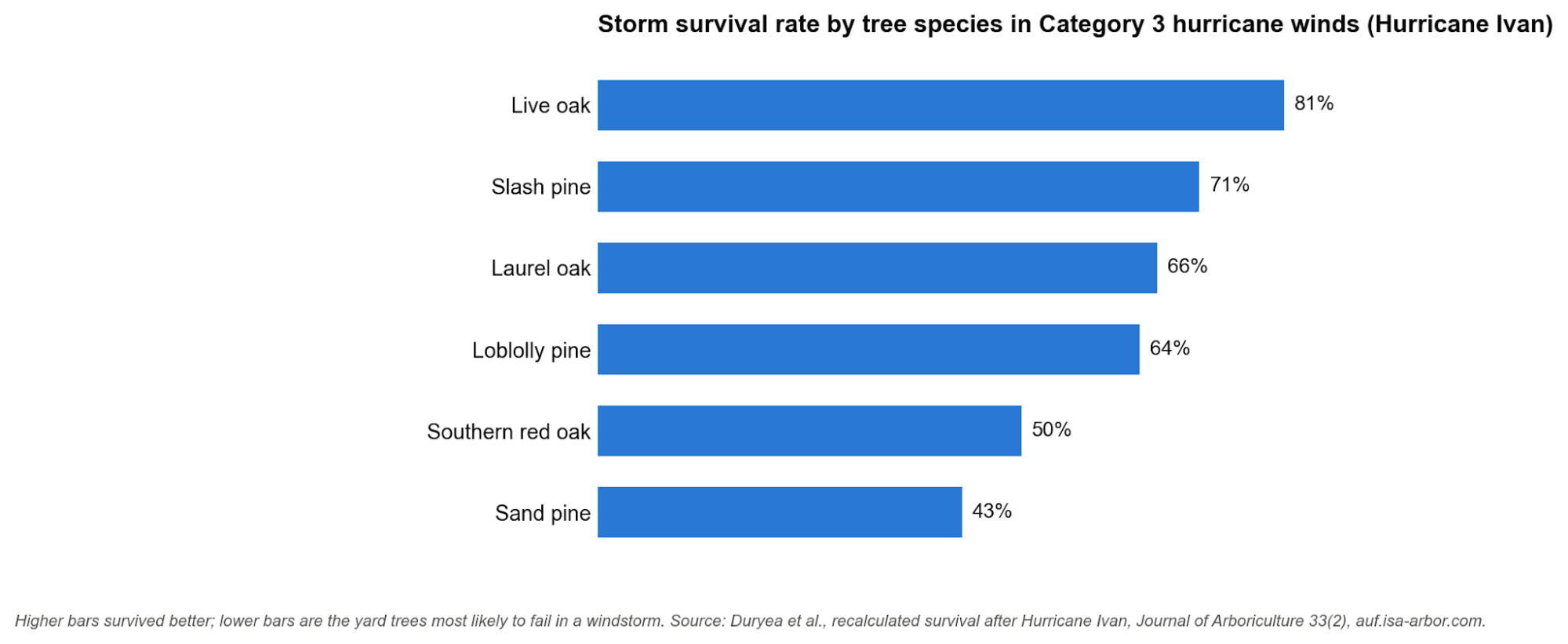
Species is the first filter, and the gap is wider than most homeowners expect. After Hurricane Ivan, researchers went back and recalculated which southern species were still standing, and live oaks outlasted sand pines by nearly forty points. Condition is the second filter, and it can be measured rather than guessed. Forest Service work on black oaks put the odds of death at 2.0, 6.5, and 29.7 times those of healthy trees for slightly, moderately, and severely declining crowns. Wind does the pruning nobody asked for, and it starts with whatever was already dying.
The Signs A Trunk Is Already Compromised
Storm seasons have not been getting quieter. The Insurance Information Institute reported in April 2026 that a rare EF5 tornado struck North Dakota last June, ending a 12-year absence of that rating. Wind keeps finding the same weak points on a trunk, and you can check every one of them in a slow lap around the tree. A vertical seam running up the bark is the loudest signal, and a mushroom shelf near the base means decay is well along inside. The defect we run into most in older subdivisions is the tight V where two trunks meet. Arborists call that included bark, meaning the stems grew so close that bark got pinched between them instead of solid wood.
Roots And Soil Tell An Early Story
The ground warns you before the trunk does. Walk the high side of any leaning tree and look for heaved soil or a gap where the root flare lifts away from the dirt. A root plate that is moving in saturated Arkansas clay after three days of rain is a failure already in progress, not a future one. Any tree service Cabot AR crew will tell you the lean matters less than whether the lean is new, and a photo from last summer settles that in a minute. The Weather Channel's storm safety guidance recommends removing a leaning tree immediately rather than watching it another season, especially when it leans toward the house. Old trenching counts too, since roots cut on one side of a tree show up as failure on the other.
What Happens After You Call
Say the safety part plainly. Do not climb, cut, or rope a compromised tree yourself, and stay out from under it while the wind is up. Federal guidance from the USDA Climate Hubs on wind and ice damage is to remove hazard trees as quickly as possible, especially where people and vehicles pass below them. In practice the first week after your call is an assessment visit and a written plan naming each tree, the method, and the price. Routine residential removals tend to schedule within 10 days, and by week two there may be a crane in the driveway if the tree stands close to the roof. Stump grinding usually trails the removal, and month three is when the ground has settled enough to reseed.
A Simple Pre-Storm Walk Around The Yard
Give the walk thirty minutes and a notebook. Honestly, on a half-acre lot with four or five mature hardwoods, plan on an hour, since the root checks are the slow part. Start at the property line and work toward the house, ranking each tree by what it would land on rather than by how it looks. Anything within reach of a bedroom or the driveway goes at the top. Write down the leaners, the thin crowns, the cracked forks. Then get someone qualified out to the three or four you flagged, while the weather is still calm enough to work in.